Case study · 04
Volta left Salesforce, and a new hire no longer means a new licence.
Volta Compliance ran its whole business on Salesforce, at about £12,000 a year in licences and more with every hire. We built Voltaforce to replace it: one web app for sales, projects, engineers, proposals and invoicing, connected to Gmail, Google Calendar and Xero. Every Salesforce record came across, and the figures were checked against Salesforce's own totals. It took about five weeks, and because there is no per-user licence, growing the team no longer grows a licence bill.
At a glance
- Client
- Volta Compliance
- Website
- voltacompliance.com
- Built
- One web app for sales, projects, engineers, proposals and invoicing
- Replaces
- Salesforce at about £12,000 a year, and PandaDoc at about £1,200
- Systems
- Google Workspace, Xero, Recall.ai, Anthropic Claude, Google Places
- Users
- About ten a day, from the office to engineers on site
- Timeline
- About five weeks, from first screens to go-live
- Status
- Live since 6 November 2026
- Relationship
- Group company. Richard is a director.
Salesforce ran the business, and charged for every person in it.
Volta Compliance tests, certifies and installs electrical systems for commercial and industrial sites across Yorkshire and Lancashire. About ten people use the system every day: sales, the office, the Qualified Supervisor and the engineers on site. Sales, projects, engineers, invoicing and what was said to clients all ran through Salesforce.
It was the business's backbone and its biggest fixed cost. Around £12,000 a year in licences for the current team, rising with every person hired. Around it, PandaDoc for proposals at about £1,200 a year, a separate Xero integration, and charges for storing files.
And it had been shaped for someone else. It was heavily customised, with 312 reports of which 91 were still used, so every change cost time and money. The gaps were worked around rather than fixed: no reliable phone notifications for engineers, a calendar so poor the team kept Google Calendar open beside it, and email logging that missed messages.
Everything Salesforce did, and the things it never did well.
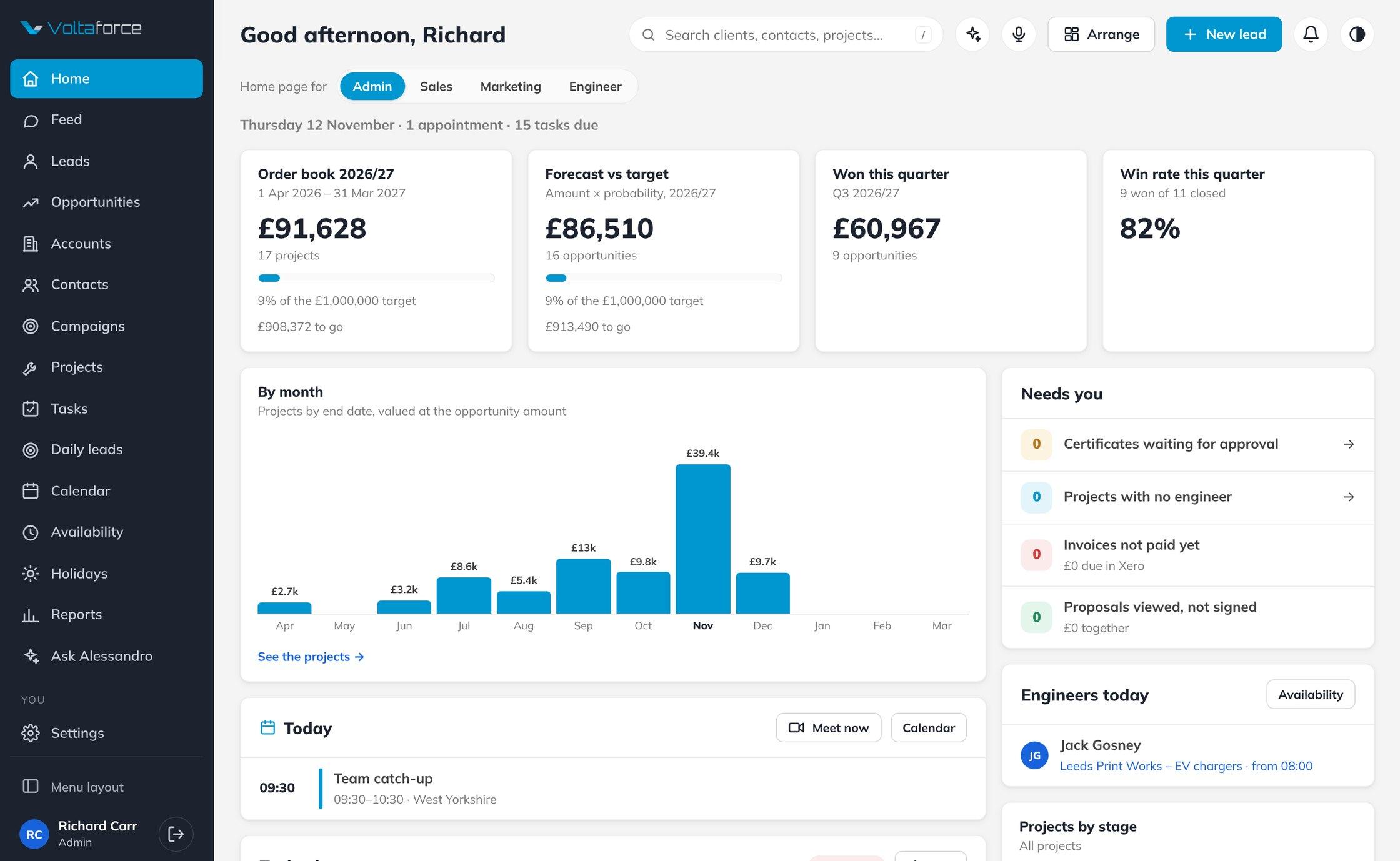
One web app on desktop, tablet and phone, with a different home page for each role. Salesforce's fields and stages were rebuilt, so the team kept the way they already worked.
What we built
On site
Projects and engineers
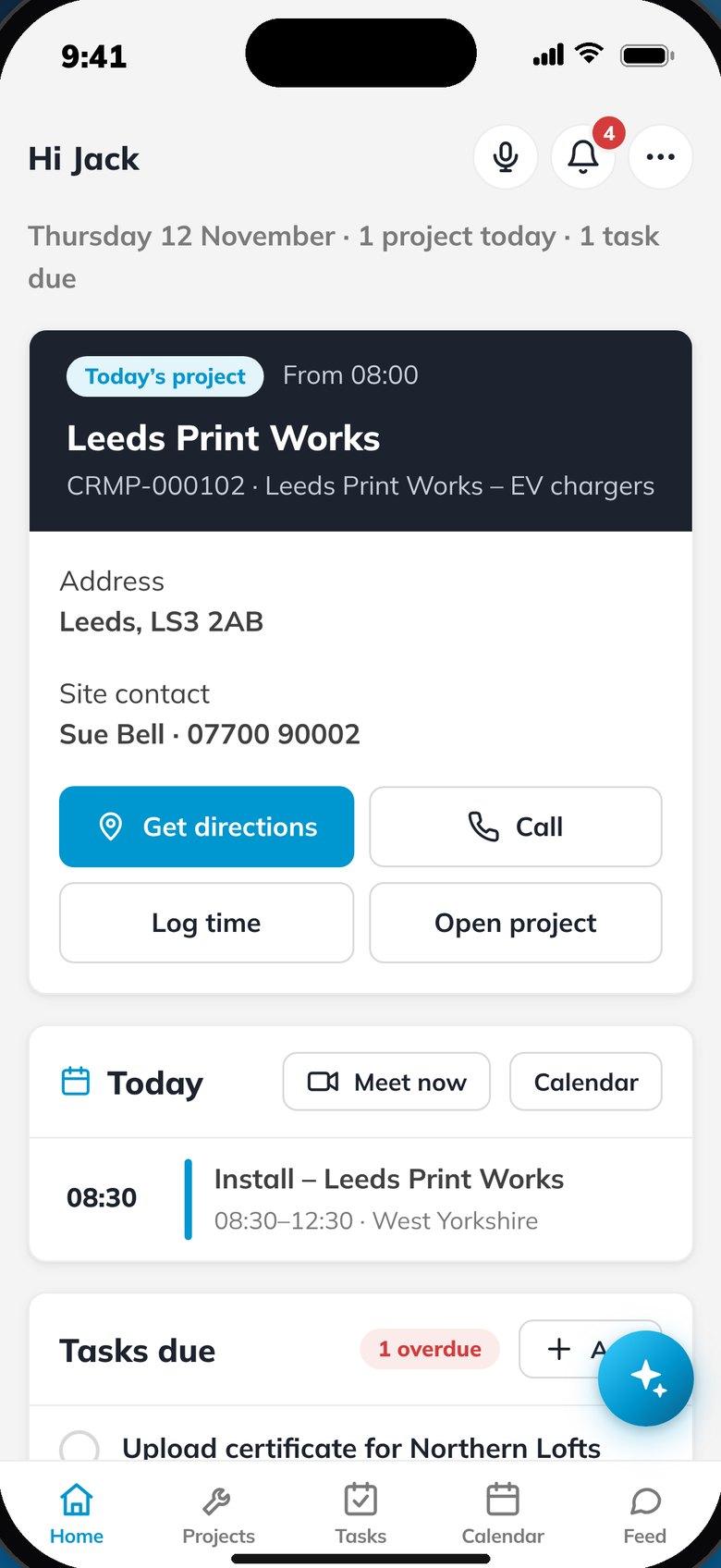
Each engineer's home page shows today's job, directions, the site contact and one-tap logging, with notifications on their phone.
In the office
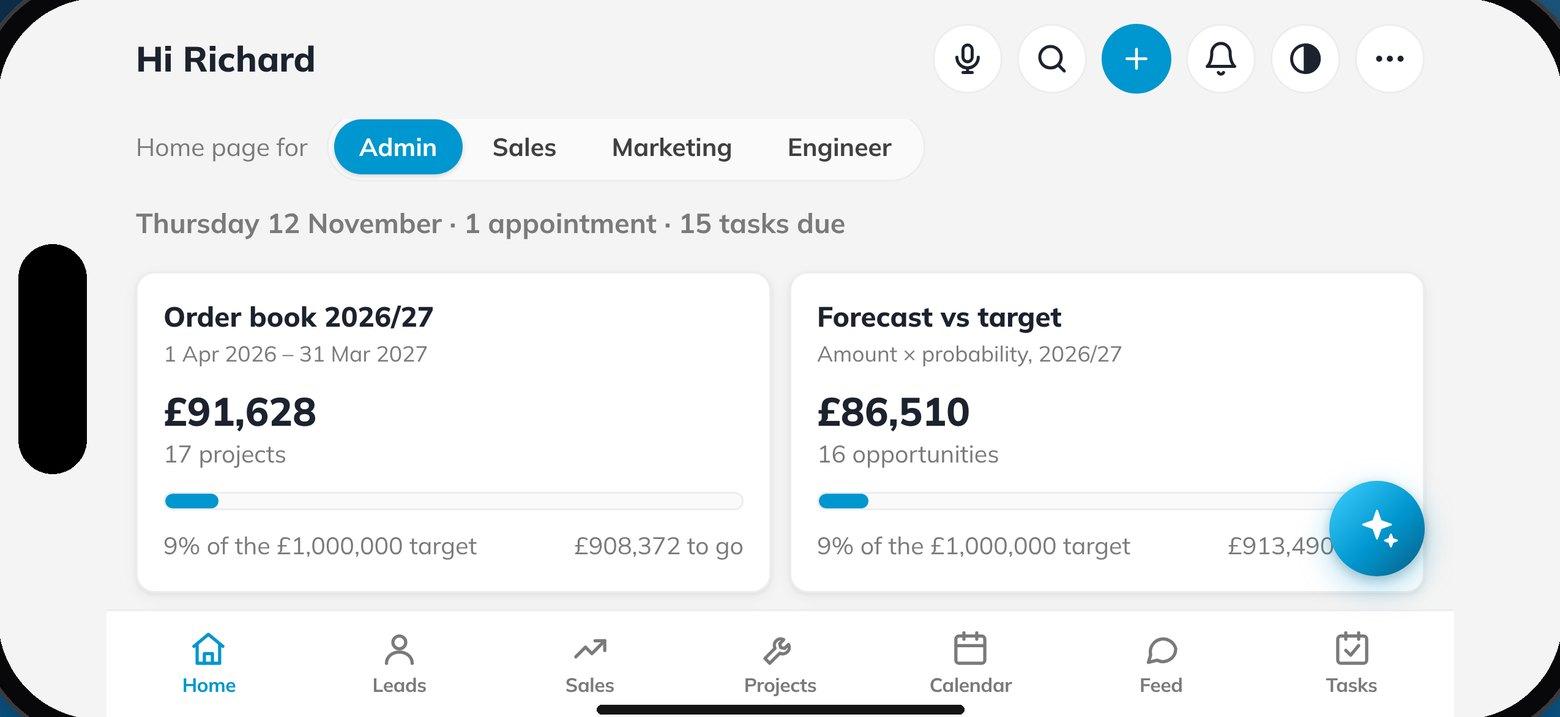
A home page for each role
Admin, sales, marketing and engineers each open to their own page. The office sees the order book and the forecast against target. An engineer sees today's job.
And the rest of it
Sales, lead to signed proposal
Proposals go out online, show when opened, and come back signed. PandaDoc went.
A morning call list
Scored from Volta's own history: clients due again, and quotes worth another try.
Gmail and Google Calendar, both ways
Emails filed against the right client. Moving a booking in Google moves the project.
Xero for invoices and holidays
Draft invoices from won work. Approved holidays go to Xero Payroll.
The same reports
The seven dashboards the team used, checked against Salesforce to the penny.
Every record brought across
Including 56,000 archived tasks Salesforce hides after a year.
The swap-over was a Friday afternoon, not a weekend. The live system runs on the same database the team tested on, so going live on 6 November was a short checklist after work: final import, clear the test records, renumber, switch Salesforce off. Salesforce stays readable until January as a fallback.
Two jobs, and the decision it leaves to you.
AI
It answers questions about the business
Ask Alessandro takes a question in plain English and answers it.
AI
It writes up the meeting
A notetaker joins Google Meet calls, and the meeting is summarised with its action items.
You
You approve the action items
They become tasks only when someone approves them.
The part that matters
The careful parts are the things it will not do.
A system that does a lot is easy to promise. The decisions worth showing you are the ones where it could have acted and was built not to.
It will not guess where an email belongs
It files an email against a client and opportunity only when it can be sure.
It will not let anything go through twice
Accepting a proposal checks every price again and locks it, so it cannot be signed twice. A draft invoice is raised once, even if two people press the button.
It will not wipe data because Salesforce said so
Records deleted in Salesforce during the move were archived, not deleted, with limits so a bad query could never empty the database.
It will not let in anyone from outside the company
Google sign-in with 2-Step Verification, company accounts only, a log of every sign-in and failed attempt, and one tap to sign out on every device.
The licence bill stops in January, and hiring no longer adds to it.
Volta's Salesforce contract ends in January 2027 and is not being renewed. That is about £12,000 a year in licences for the current team, from Volta's own contract. PandaDoc, about £1,200 a year, is no longer needed.
Salesforce licences · about £12,000 a year
PandaDoc · about £1,200 a year
Salesforce charges for every person, and Volta expects its team to double. The new system has no per-user licence. It costs tens of pounds a month to host, plus small usage charges for the AI features and address lookups.
And it fits the business rather than the other way round. Engineers get notifications on their phones, signed proposals land in the order book on their own, and every email and appointment ends up against the right client without anyone copying it across.
Laravel (PHP), hosted on Laravel Cloud. About 34,000 lines of application code and 277 automated tests making about 3,280 checks, run before every change, measured from the repository at go-live. 41 database tables built through 43 migrations. 13 scheduled jobs, syncing Google every five minutes and Xero every ten. Salesforce matched record by record on its own IDs during the move. Phone notifications built without a third-party service. Signed proposals carry the time, IP address and a digital fingerprint.
Next step
Twenty minutes, no obligation.
If you pay for every seat on software your team works around, that is worth a conversation. Tell us what it costs you and what you work around.
Would rather write than talk? Send us a message instead and it reaches the same two people.